
Friday 9 October 2026
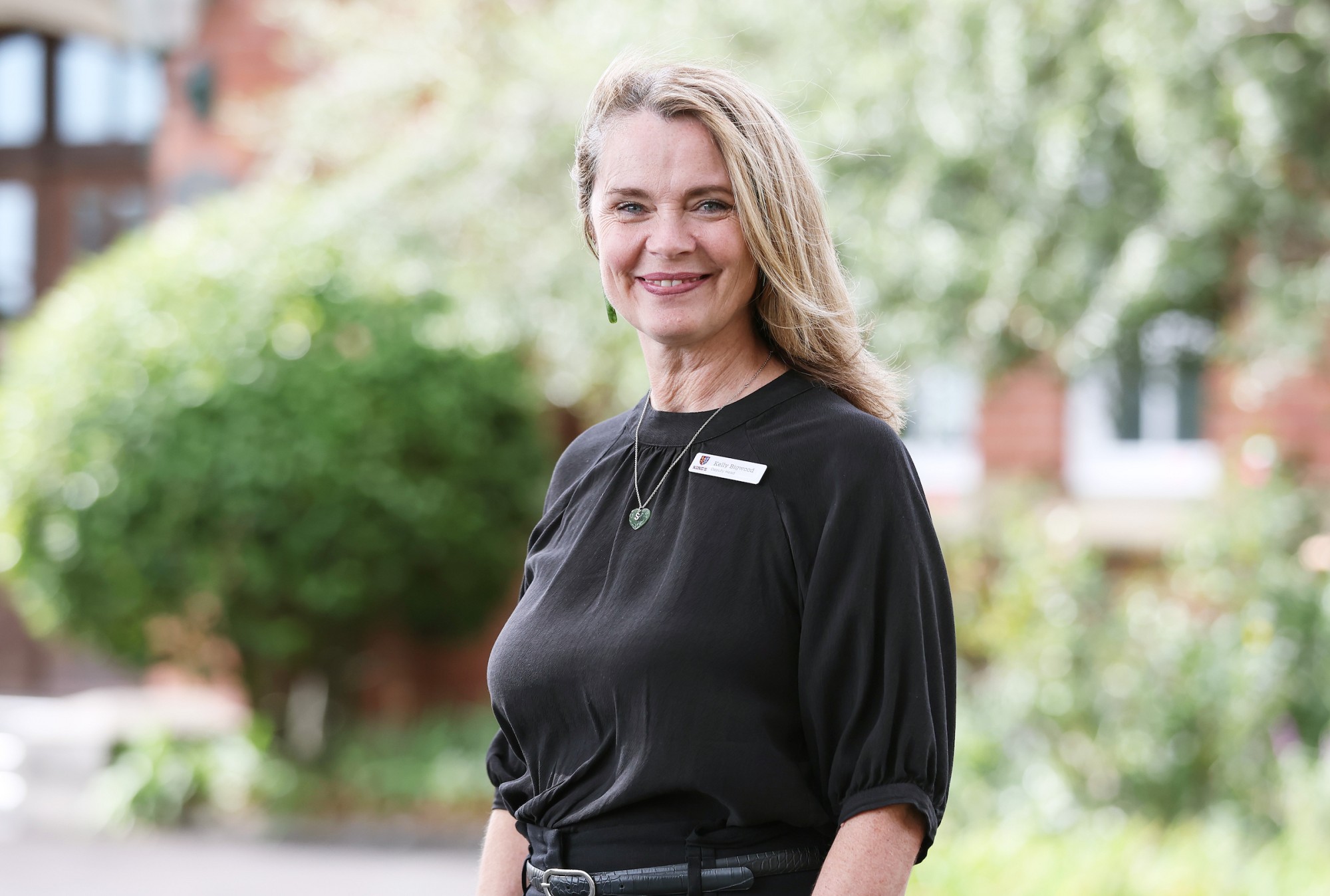
This week, we talked with our Deputy Head of Pedagogy, Kelly Bigwood. In this role, Ms Bigwood is responsible for ensuring that current and future staff are professionally and personally supported, assisting them in receiving the best possible learning experience in the best possible learning environment.
When asked about her philosophy for pedagogy, Ms Bigwood replied; "My philosophy for pedagogy falls into three key parts."
"Firstly, it's about how we establish optimal conditions for learning. It's akin to the roots of a tree in the learning rainforest, as written by Tom Sherrington in The Learning Rainforest: Great Teaching in Real Classrooms. The roots that grow downwards create strong foundations for learning and routines that reduce cognitive load. We also look to honour error and mistakes in our foundations. We care about you, your learning, and your feelings of belonging. Kotahitanga is important at King's College — the feeling of belonging in the classroom. If these roots that enable optimal conditions for learning are strong and in place, then even when the wind blows, the tree will stand firm.
The second part is to clearly understand how we learn and therefore how we teach. Establishing conditions for learning, and then understanding how we learn before how we teach, is very embedded within the principles of the mind in understanding how people learn. The small working memory, unlimited long-term memory, how we encode, and how we retrieve.
The third part, however, comes before all of that. It's what we actually teach in our curriculum. Our curriculum has to be cohesive, aligned, and rich with essential learning that forms a pathway for the higher levels of learning. So, there is a lot of planning involved, and it has to integrate the principles of how we learn. So, the pedagogy and the curriculum are highly intertwined. All three parts are."
Often, we think about a curriculum as planned lessons and content to guide student education. However, Ms Bigwood firmly believes it is so much more than that.
"When we understand how people learn, we have to know that there are plenty of opportunities for retrieval. For example, when checking for understanding and it isn't yet there, we have to think about ways we can create those opportunities differently. We have to make sure that we are very clear on what content is essential, and that it is worth investing in those pedagogies. What is the content that must be retained in our long-term memory, in order to free our working memory for learning and problem-solving?
We want our rangatahi to know things. Historically, when the 2007 New Zealand Curriculum was introduced, it was heavily skills-based. We have learned to value things like problem solving and critical thinking, which truly are valuable, but what about true knowledge? Whether it's factual, procedural, etcetera, all sorts of knowledge is needed for us to be able to problem solve, think critically, and participate in high-level thinking.
It's a trajectory, and we really want to keep that balance. We want our rangatahi to be future-focused and ready. That's one of our key pillars. So, if we want them to be future-ready, we have to guide them beyond memorisation of facts. The knowledge is the foundation for being able to explore the canopy of the learning rainforest."
In May 2026, the Ministry of Education announced changes to the NZQA curriculum, for which a new foundational qualification will be introduced for Year 11 students in 2028, followed by Year 12 in 2029 and Year 13 in 2030.
The new qualification structure will move away from standards-based assessment, and will instead be based on coursework and examinations. A key focus for the College moving forward will be ensuring strong alignment across Year 9–11 programmes, so that students are well prepared for success in the senior school qualifications.
Increased moderation processes will also be implemented to ensure greater consistency and fairness across schools nationwide.
Further details regarding the change can be found here.
When asked how these changes to NCEA will affect the King's College approach to pedagogy, Ms Bigwood replied:
"Our Headmaster, Patrick Gale, was deeply involved in the development of these changes. So, I'd say that this new curriculum will complement the College's approach to pedagogy incredibly well. The new curriculum places more emphasis on knowledge and practice, and these new standards for the teaching profession all align very well with our philosophy.
The key takeaway for us, regarding this philosophy for teaching and learning, is that we want our teachers to have a long-term understanding of how people learn and automaticity and strategies that align with that, so that they are able to be responsive practitioners and adaptive experts.
If we want all of our students to achieve academic success, we cannot leave teaching and learning to chance. We want to diminish the lottery effect — it doesn't matter who you get, you just know you are going to have a highly effective teacher.
So yes, I think that our pedagogy aligns very well with the changes coming in. We believe that NCEA has served a very good purpose and supported countless students in their future careers. However, it neglected a cohesive body of knowledge while relying on autonomy and the individual expertise of teachers who were developing using that curriculum. It's important to understand that conditions for teaching and learning are not uniform across the board, for example, staffing in isolated areas often means that those teachers are expected to develop their own curriculum.
These changes to educational standards are going to give us a domain-specific and cohesive curriculum, which I believe is a very positive thing. It is very important that all of our community is served, which I am aware is a concern for some that not all of our community is served across the motu. There are different beliefs under that, as well, in terms of equity. NCEA aimed to improve equity, but it perhaps hasn't played out that way. So, some parts of our community have been under-served as a result of that."
For our teachers to have a long-term understanding of automaticity and strategies that align with how people learn, it is important to guide them towards this understanding. So, how can we direct teacher learning with this goal in mind?
"Akin to how we discussed our optimal conditions for learning for our students, we want our teachers to have that as well. It's important that our educators feel that they are in an environment where it is safe for them to make mistakes, they can be reflective, and that they are honoured for that, as well as trying things that might be a little bit different. As leadership, we need to model openness and vulnerability to show that it is respected, and that King's College is a safe place for our people to grow and flourish.
We are privileged to have some very experienced teachers who likely don't think explicitly about what they're doing, but what they are doing is really something incredible. By perpetuating an environment that encourages that, the College becomes a better place for everybody. Right now, we are working together to establish a set of beliefs surrounding teaching and learning, which starts with making sure everyone is on the same page. We are engaging in research which will ground the basis of these beliefs, but is also informed by what we see around us. Once established, we're then able to develop a range of observation tools in the classroom which align with that framework. The data that these tools will gather for each teacher will be pivotal in helping us to see if there is a gap between what our beliefs are, and what is being practiced, so that improvements can be made to reduce that gap and increase alignment with the framework.
Teacher learning is highly complex. We all have our own educational experiences, how we were mentored, and our beliefs and values that underline what we do. Not only do our teachers need to feel safe putting those beliefs on the table, but they need them to be heard, unpacked, and then built up together. However, if teachers don't feel supported in this way, then we're not going to get a long term buy into a teaching and learning framework.
We've got some truly amazing teachers here at King's, and we want to make sure that we've all worked together on that framework. Once we unpack those beliefs for what teaching and learning mean, it's very hard not to look at your practice differently. It's complex but it's so, so exciting."
Teacher learning within the College is an integral part of the King's College pedagogy, but we also work to train aspiring teachers through partnerships with tertiary institutions. So, how does our teacher training programme work, and what's in it for us?
"What began as a teacher training programme solely in partnership with the University of Auckland has branched out to increase breadth of focus across New Zealand universities. We have a very strong partnership with the University of Auckland's teacher and schools programme, and we're also very involved within the teaching institute, but we see our role as a school in training teachers as absolutely pivotal to the success of education in New Zealand. If schools are not playing a part in this training, then who is?
I was involved in some University of Auckland research around the teacher and schools programme, and our efforts have great feedback. It's down to more than the lunches and the iPads — a lot of it is actually Carissa Gordon who does an exemplary job looking after them.
Our pre-service teachers are often based in King's College for a whole year, usually coming in three to four days a week with one or two days to work on their studies. This really immerses these teachers in life at the College, coming in at the beginning of the year and seeing how each semester plays out from the start of each class to the end of each day. On a Tuesday lunch time, Ms Gordon runs a professional development session for them.
We've got some amazing mentors here, and it's hard to be a mentor to pre-service teachers because you're giving up your space in the classroom, and you're teaching them in addition to your students. But, I've just spoken to one of our current pre-service teachers from the University of Auckland, and she was telling me about how amazing her mentor is! Which is really great, because her mentor has also told me how amazing she is, and how much he is unexpectedly learning from this experience.
That's the win-win. When you get a pre-service teacher who has great professional disposition and is able to work collaboratively, you effectively have two teachers in the classroom for a time while they are learning to teach. The mentor teacher often has to be very explicit about what they do implicitly, because they are not necessarily thinking about their practice on a daily basis. So, it's really good for the mentor teacher to jog their brain a bit and articulate what they are doing. It's amazing for their reflective practice.
At the end of the year, you really do hope that you have a position available for them, but you may or may not. If you do, however, their learning is accelerated because they didn't have to start the year off getting settled into life at King's and the way that we do things here — our culture and our routines."
When asked what the "ideal mentee teacher" looks like, Ms Bigwood replied;
"Openness to learning is the key thing that we look for. Having that disposition of growth is at the top of the list for us. We're developing that framework about what effective teaching and learning looks like, which enables us to have a shared language, and a shared understanding of what high-quality practice looks like. Pre-service teachers will always come in with their own set of beliefs which are based on their personal experiences, so, I would love for them to also be open to what they're going to learn here, and what they're going to be challenged by.
In all honesty, when I was training to be a teacher in 1993, I really thought I knew it all! But, the more I learned, the more I knew I didn't know. After 33 years, I still think to myself that I could do particular things differently, and plan out how I can achieve that. That's one of the biggest things, is that our pre-service teachers are open to learning, resilient, and genuinely of the disposition where seeking feedback is a good thing.
In my previous job, I worked for the University of Auckland in Teacher Education. That disposition of openness, the perfectionists often struggle with, because they're going to get feedback. Feedback is awesome, and it's a great thing to receive! But what they often do is then think that they've messed up somehow, and that they are not meant to be teachers. But, they are! Keep at it. The unideal candidate might say "Well, how important is planning anyway?" But, we know that our kids deserve better. So, I see this as a very high stakes career. That resilience around being able to be pragmatic and acknowledging your mistakes, to then use them as a learning experience, is so important.
To add on to that as well, in all honesty, we want great people. We can teach you to teach, but your inclination to go above and beyond in your role is absolutely golden. Teachers who immerse themselves in College life, going to the musical showcase, helping out with productions, and even creating resources for others to explore, are so precious to us. We can teach you to teach, but we want someone who is also keen to be a part of the team, loves their subject, and seeks to connect. Those kinds of things are much harder to learn, so it's a really valuable trait to us if you're a go-getter!"
"Building teacher knowledge so that we don't leave teaching and learning to chance and so that every student can achieve academic success, is something we're all working collaboratively on. The King's pedagogy works towards giving everybody a solid learning trajectory — students, staff, and pre-service teachers undertaking their practicum. We are focused on people and growth, and we have great clarity around high quality teaching and learning, based on an understanding of how people learn. Research-informed, evidence-based, beliefs. That's where we aim to be, and that's what we're actively working towards."